Ongoing projects
My research explores the potential of combining multiple disciplines across geobiology, molecular biology and biophysics to elucidate the inner working of biological membranes and their possible evolutionary patterns on Earth and other planetary settings.
1. Reconstruction of primordial biological membranes and their biophysical characterization
This ambitious project aims to experimentally reconstruct ancient cellular membranes and elucidate their evolutionary history through characterizing biophysical properties of those membranes that correspond to different geological times and settings. We particularly focus on a special group of membrane lipids called terpenoids. Terpenoids are the only known lipids that are distributed in all three domains of life (Bacteria, Archaea and Eukarya), unlike the more well-studied fatty acyl phospholipids that are predominantly found in Bacteria and Eukarya. Intriguingly, terpenoids in different domains have distinct chemical structures and thus seem to alter the biophysical properties of host membranes differently. We utilize artificial lipid membranes (liposomes) to simulate ancient cellular membranes and measure their biophysical properties using e.g. optical microscopes and atomic force microscopes (AFM).
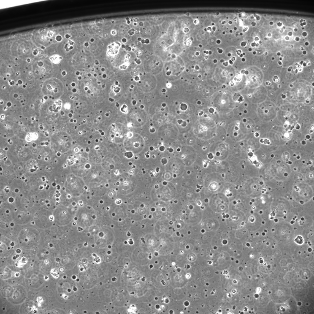
Fig. Liposomes having a eukaryotic-type lipid composition (dark grey dots).
Genomic analyses of lipid biosynthesis in modern organisms enable us to infer not only the lipid repertoire of ancient organisms, but also ancient enzymes that produced lipids that are now ‘extinct’. For instance, Bacteria and Eukarya have distinct polycyclic terpenoids called hopanoids and steroids, respectively. Their recalcitrant structure and the near exclusive taxon specificity let them serve as taxonomic biomarkers for bacteria and eukaryotes (see also my completed projects 1 and 3). For example, cholesterol is a characteristic steroid of animals, including humans. Apart from the utility as biomarkers, polycyclic terpenoids are indispensable membrane components regulating complex membrane dynamics. Hence, these terpenoids are promising molecular tracers for the evolutionary trajectory of membrane dynamics over the geological time scale. We are currently resurrecting ancient enzymes for polycyclic terpenodis and analyzing lipid products that were presumably in operation some time around 2-3 billion years ago (see also my completed project 2).
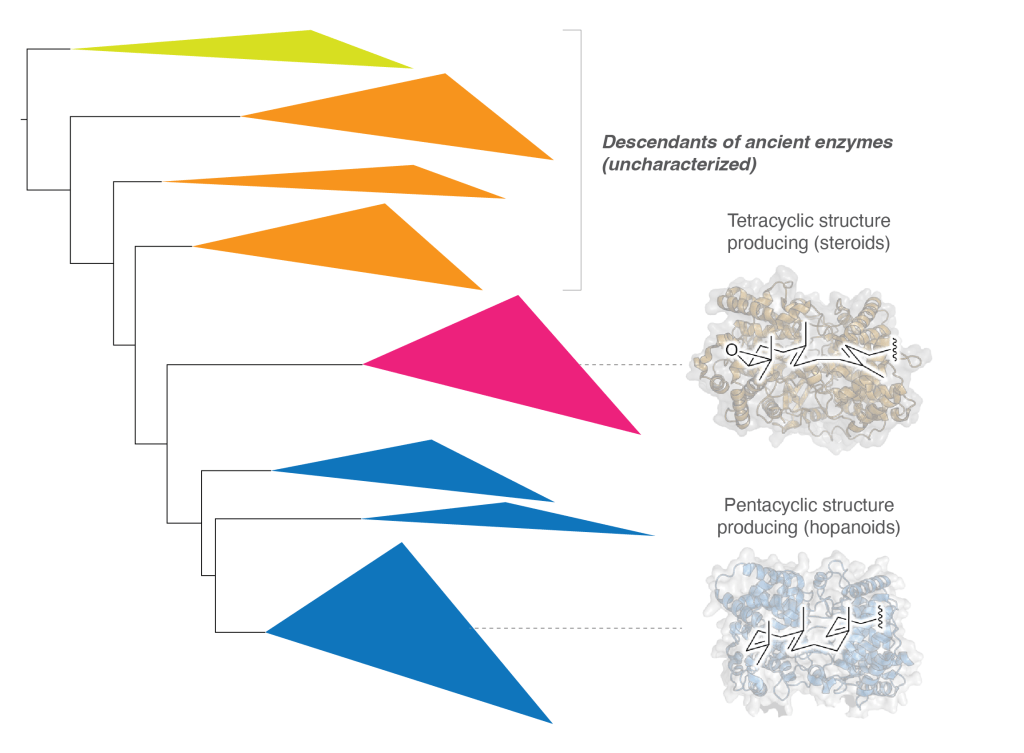
Fig. Phylogenetic tree of polycyclic terpenoid synthases. Modern genome data reveal that hopanoid- and steroid-producing enzymes are only derived forms within this large protein family. In reality, the family contains a diverse range of uncharacterized proteins that descended from enigmatic ancestral enzymes. These ancestral enzymes presumably produced ‘extinct’ terpenoid lipids and may have sustained membranes with distinct biophysical properties from those of modern membranes.
Collaborators
Andreas Schneider (Institute of Biotechnology and Drug Research, Mainz, Germany)
Kingo Takiguchi (Nagoya University, Nagoya, Japan)
References:
Y. Hoshino (2024) Terpenoids and membrane dynamics evolution, Frontiers in Ecology and Evolution, 12:1345733. Link
Y. Hoshino & L. Villanueva (2023) Four billion years of microbial terpenome evolution. FEMS Microbiology Review 47, fuad008. Link
J. Sáenz, D. Grosser, A. Bradley, T. Lagny, O. Lavrynenko, M. Broda & Kai Simons (2015) Hopanoids as functional analogues of cholesterol in bacterial membranes. Proc. Natl. Acad. Sci. USA, 112, 11971-11976. Link
2. Emergence of the primordial protein world from prebiotic amino acids
Amino acids are building blocks of proteins. Modern proteins consist of 20 canonical amino acids (called proteinogenic amino acids), but it is not clear how many of them were present on the early Earth at the origin of life. There are multiple abiotic sources of amino acids, but currently the most well-known are meteorites, producing as many as 12 proteinogenic amino acids. Yet, this is still a little more than a half of the modern repertoire. This observation implies that the earliest life was made up of either a limited number of amino acids, or a mixture of ~12 proteinogenic amino acids and other amino acids that are not utilized any longer in modern organisms. For now, we set aside those unknown amino acids and start with the proteinogenic amino acids that could be present on the early Earth.
Our project aims to elucidate what combinations of amino acids are critical for generating a functional protein fold. Among thousands of protein folds, only a handful of them are thought to be of an ancient origin before the era of the Last Universal Common Ancestor or LUCA. A classic example includes the Rossmann fold that enables host proteins to bind to nucleotides, thereby implying an ancestral relationship between proteins and genetic materials that were presumably derived from the so-called RNA world. We investigate which amino acid combination can generate these ancestral protein folds by combining three distinct areas of study – meteorite geochemistry, molecular biology and protein engineering. Meteorite geochemistry can infer which amino acids were the most abundant on the early Earth. Molecular biology enables us to infer the amino acid sequences of primordial proteins at or before LUCA. Finally, protein engineering utilizing deep-learning techniques can predict how a mixture of selected amino acids generate the target protein folds.
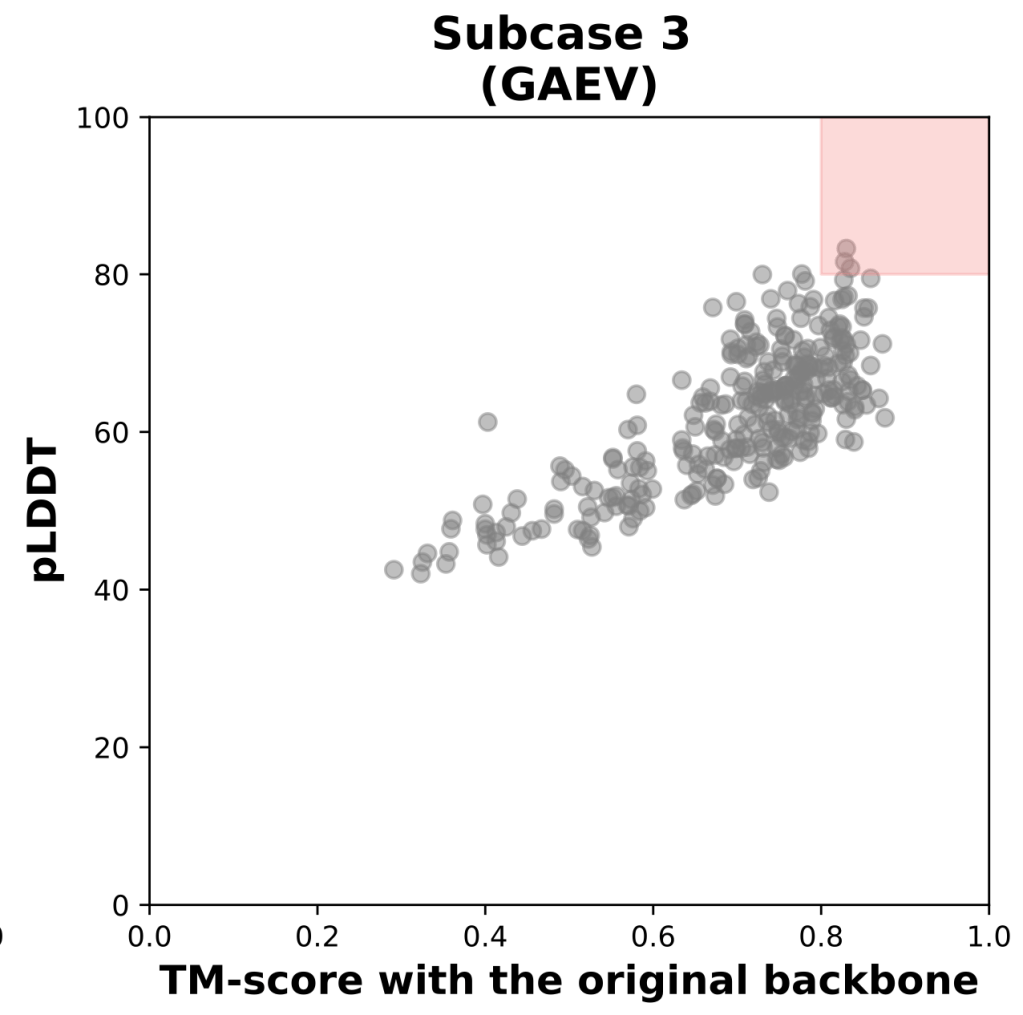
Fig. Confidence map of amino acid sequences that are predicted to generate the Rossmann fold, using only four amino acids: GAEV (pale pink region indicates high confidence).
Collaborators
Minako Hashiguchi (Nagoya University, Nagoya, Japan)
George Chikenji (Nagoya University, Nagoya, Japan)
Reference
L. Longo, J. Jabłońska, P. Vyas, M. Kanade, R. Kolodny, N. Ben-Tal, D. Tawfik (2020) On the emergence of P-Loop NTPase and Rossmann enzymes from a Beta-Alpha-Beta ancestral fragment, eLife, 9:e64415. Link
3. Evolution of eukaryotic cell wall biosynthesis
Eukaryotes produce a variety of distinct cell walls that enable host organisms to adapt to diverse environments. However, the evolutionary origin and the history of eukaryotic cell walls remain largely unsolved. In this project, comprehensive phylogenetic analyses are conducted for eukaryotic cell wall biosynthesis genes (in particular, glycosyltransferases for cellulose and chitin biosynthesis). In parallel, the taxonomical identity of cell wall remnants in the Precambrian rock record are analyzed through the comparison with modern eukaryotic cell walls.
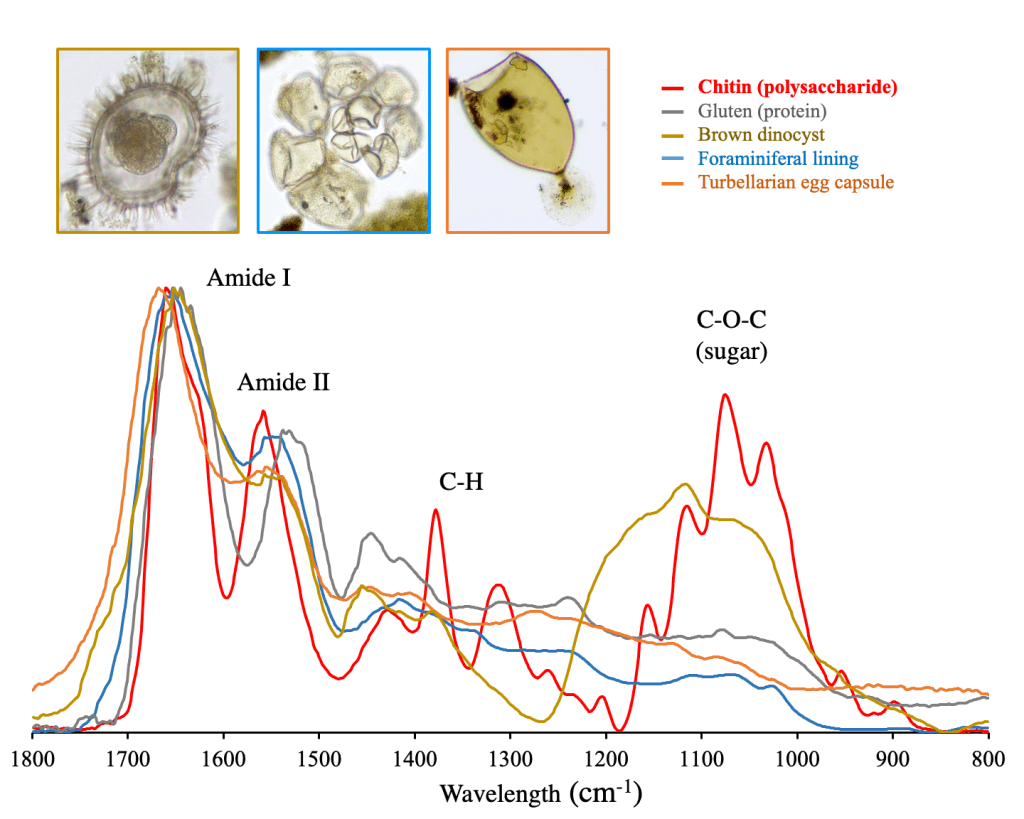
Fig. FT-IR measurements of modern eukaryotic cell walls.
Collaborator
Takuto Ando (Shimane University, Japan)
References
J. Fangel, P. Ulvskov, J. Knox, M. Mikkelsen, J. Harholt, Z. Popper, W. Willats (2012) Cell wall evolution and diversity. Frontiers in Plant Science, 3, 152. Link
Z. Popper, G. Michel, C. Hervé, D. Domozych, W. Willats, M. Tuohy, B. Kloareg, D. Stengel (2011) Evolution and Diversity of Plant Cell Walls: From Algae to Flowering Plants. Annual Review of Plant Biology, 62: 567-590. Link
Completed projects
1. Combined genomic and lipid analysis of 2-methylhopanes throughout Earth’s history
This project constrained the utility of 2-methylhopanes as taxonomic biomarkers in the geological record. 2-Methylhopanes were once hailed as promising cyanobacterial biomarkers and were extensively utilized to trace the evolution of oxygenic photosynthesis in the Proterozoic and even in the Archean. However, the subsequent discovery of 2-methylhopanoid production by non-cyanobacterial species called into question the diagnosticity of those compounds and further provoked debates on the general validity of biomarker studies in the Precambrian period.
We re-established the diagnosticity of 2-methylhopanes as cyanobacterial biomarkers by combining comprehensive genomic analyses of 2-methylhopanoid biosynthesis genes and non-contaminated up-to-date geochemical analyses of 2-methylhopanes in the geological record (see also the completed project 4 as described below). Our finding revealed that 2-methylhopanes have a certain time window that is associated with a specific taxon. In our case, those compounds were biomarkers for cyanobacteria before 750 Ma. In more recent times, the input organisms include both cyanobacteria and alphaproteobacteria and the abundance of 2-methylhopanes likely reflects the complex dynamics among 2-methylhopanoid producers and other organisms under various geological settings.
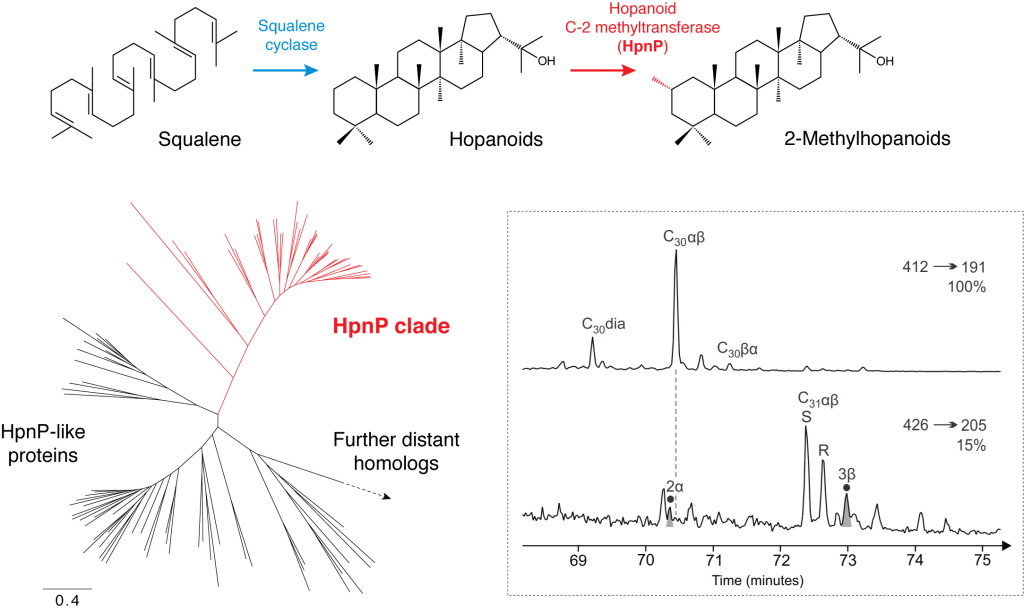
Fig. 2-Methylhopanoid biosynthesis by HpnP. In the geological record, 2-methylhopanoids are detected as saturated forms (2-methylhopanes) due to diagenesis.
Collaborators
Benjamin Nettersheim (Aachen University, Germany)
Christian Hallmann (German Research Centre for Geoscience [GFZ], Germany)
Jochen Brocks (Australian National University, Australia)
David Gold (University of California, Davis, USA)
References:
Y. Hoshino, B. Nettersheim, D. Gold, C. Hallmann, G. Vinnichenko, L. van Maldegem, C. Bishop, J. Brocks, & E. Gaucher (2023) Genetics re-establish the utility of 2-methylhopanes as cyanobacterial biomarkers before 750 million years ago, Nature Ecology and Evolution, 7, 2045–2054. Link
K. French, C. Hallmann, J. Hope, P. Schoon, J. Zumberge, Y. Hoshino, C. Peters, S. George, R. Buick, J. Brocks, & R. Summons (2015) Reappraisal of hydrocarbon biomarkers in Archean rocks, Proc. Natl. Acad. Sci. USA, 112, 5915-5920. (Geochemical Society, Best paper award, 2018) Link
P. Welander, M. Coleman, A. Sessions, R. Summons, & D. Newman (2010) Identification of a methylase required for 2-methylhopanoid production and implications for the interpretation of sedimentary hopanes. Proc. Natl. Acad. Sci. USA 107(19):8537-8542. Link
2. Resurrection of ancestral steroid biosynthesis enzymes
(funded by Agouron Institute Geobiology Fellowship)
Eukaryogenesis (evolution of eukaryotes) is one of unsolved important questions in modern biology. Steroid biosynthesis is generally thought to be nearly exclusive to eukaryotes and thus steroids are extensively utilized as eukaryotic biomarkers in the geological record to constrain the evolutionary timing of eukaryogenesis. However, recent studies have increasingly suggested the presence of steroid biosynthesis in bacteria. Thus, addressing the evolutionary implication of bacterial steroid biosynthesis is of prime importance to correctly interpret the biological identity of steroids in the geological record and understand the evolutionary origin of eukaryotes.
In this project, comprehensive phylogenomic analyses of all steroid biosynthesis enzymes were conducted. Our results suggested the bacterial origin of steroid biosynthesis and the horizontal transfer of steroid biosynthesis genes from bacteria to (proto-)eukaryotes, contrarily to the traditional understanding. Further, ancestral steroid-producing enzymes were experimentally resurrected, using the technique of Ancestral Sequence Reconstruction (ASR), and the catalytic products of resurrected enzymes were characterized to infer ancestral steroid compositions in early eukaryotes and bacteria. This project shed novel light on the process of eukaryogenesis through elucidating the evolutionary origin of steroid biosynthesis, which is thought to have been critical to form the eukaryotic-specific dynamic membrane system (see also the ongoing project 1).
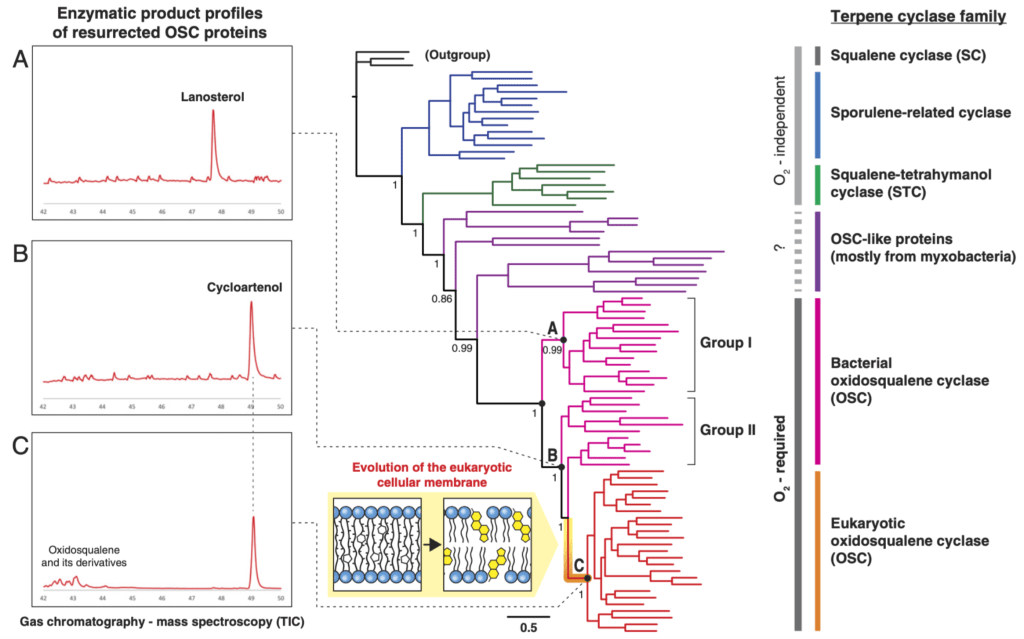
Fig. Phylogenetic tree of steroid-producing enzymes (oxidosqualene cyclase; OSC) and resurrection of ancestral OSC proteins (Nodes A, B & C).
References:
Y. Hoshino, E. Gaucher (2021) Evolution of bacterial steroid biosynthesis and its impact on eukaryogenesis, Proc. Natl. Acad. Sci. USA, 118 (25) e2101276118. Link
Y. Hoshino, E. Gaucher (2018) On the origin of isoprenoid biosynthesis, Molecular Biology and Evolution, 35, 2185-2197. Link
J. Wei, X. Yin, P. Welander (2016) Sterol Synthesis in Diverse Bacteria, Frontiers in Microbiology, 7:990. Link
3. Neoproterozoic diversification of aerobic organisms
The evolution of complex multicellular organisms such as animals and plants is a hallmark of the aerobic evolution of life. However, the environmental setting that paved the way to this one of the most important evolutionary events on Earth remains enigmatic. This project examined the eukaryotic biomarker record (steranes) in the Cryogenian and the Ediacaran and discovered an abrupt and substantial shift of sterane composition that seems to reflect a drastic rearrangement of ecosystems at the terminal Proterozoic towards the onset of the Cambrian Explosion. Our results suggested that the primary production dominated by cyanobacteria for the most of the Proterozoic ended during the Cryogenian, followed by the rise of eukaryotic algae as the new major primary producers. The data particularly suggested the rise of green algae as the dominant producers. The project outcome substantially enhanced our understanding about the ecological evolution from ancestral cyanobacterial ecosystems towards modern algal-based ecosystems.
This project was only enabled by the establishment of non-contaminated sampling method for organic-lean Precambrian rocks as described in the completed project 4 below.
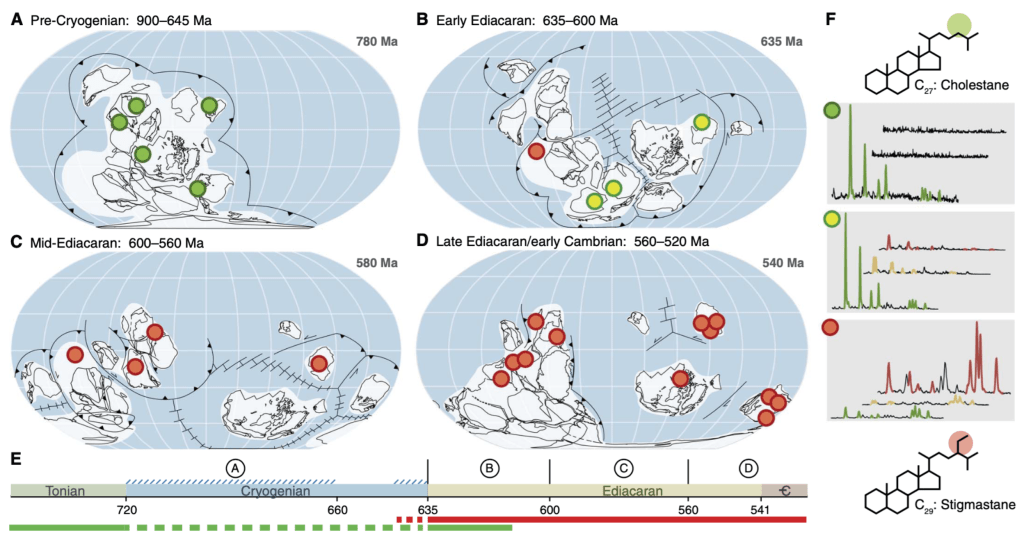
Fig. Sterane compositional shift from the Cryogenian to the Ediacaran (C27, C28 and C29 steranes).
Collaborators
Jochen Brocks (Australian National University, Australia)
David McKirdy (University of Adelaide, Australia)
Shuhai Xiao (Virginia Polytechnic Institute and State University, USA)
Supriyo Das (Presidency University, India)
Malgorzata Moczydlowska-Vidal (Uppsala University, Sweden)
References:
Y. Hoshino, A. Poshibaeva, W. Meredith, C. Snape, V. Poshibaev, G. et al (2017) Cryogenian evolution of stigmasteroid biosynthesis, Science Advances, 3: e1700887. Link
J. Brocks, A. Jarrett, E. Sirantoine, C. Hallmann, Y. Hoshino, T. Liyanage (2017) The rise of algae in Cryogenian oceans and the emergence of animals, Nature, 548, 578-581. Link
4. Re-assessment of Archean biomarker records
In this project, we developed an unprecedented hydrocarbon-clean protocol to collect and process Archean rock samples from the Pilbara region in Western Australia and demonstrated that once-considered authentic ‘Archean’ biomarkers are most likely contaminants that were introduced during sample handling. This project was performed by a consortium of five geochemistry labs in the world, including the Australian National University, Macquarie University, Massachusetts Institute of Technology, University of California Riverside, and the Max-Planck Institute for Biogeochemistry. As a positive corollary from the project outcome, the burden of proof for the detection of indigenous and syngenetic biomarkers throughout the Precambrian was significantly raised and led us to systematically (re-)analyze both previously studied and new Proterozoic sedimentary sequences with an unexpected findings (see also the completed projects 1 and 3 described above).
In parallel to the drill core analyses, Archean outcrop samples were also collected across the Pilbara region and analyzed to evaluate the preservation potential of hydrocarbon biomarkers.
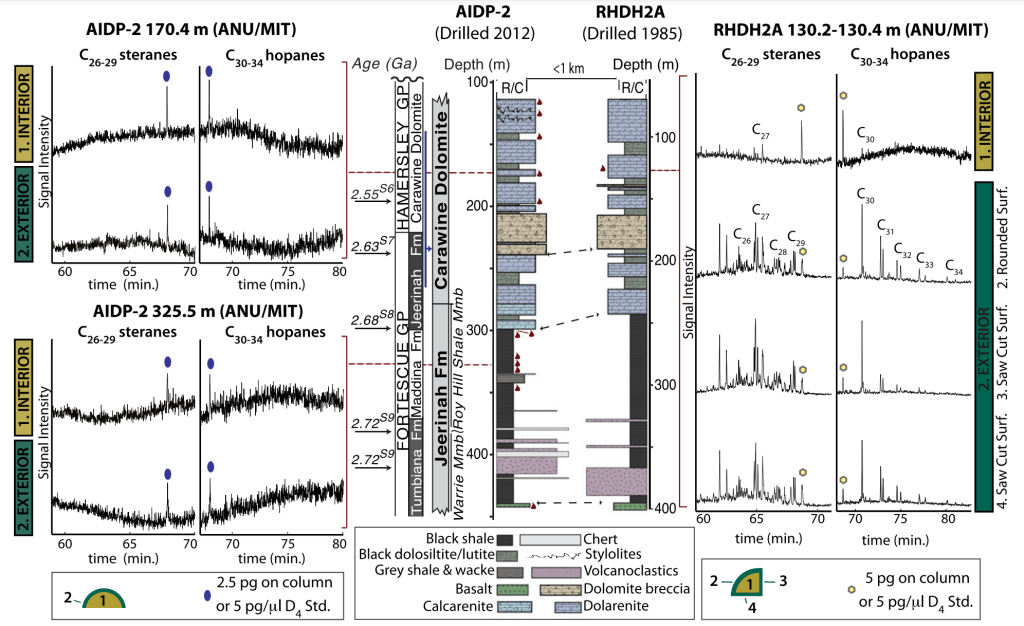
Fig. Non-contaminated Archean rock samples (left; AIDP-2) and previously-drilled contaminated Archean samples with substantial amounts of hopane and sterane biomarkers (right; RHDH2A).
Collaborators
Drill core analyses
Roger Summons (Massachusetts Institute of Technology, USA)
Jochen Brocks (Australian National University, Australia)
Gordon Love (University of California Riverside, USA)
Outcrop analyses
David Flannery (Queensland University of Technology, Australia)
Malcolm Walter (University of New South Wales, Australia)
References
K. French, C. Hallmann, J. Hope, P. Schoon, J. Zumberge, Y. Hoshino, C. Peters, S. George, G. Love, R. Buick, J. Brocks, R. Summons (2015) Reappraisal of hydrocarbon biomarkers in Archean rocks, Proc. Natl. Acad. Sci. USA, 112, 5915-5920. (Geochemical Society, Best paper award, 2018) Link
Y. Hoshino, S. George (2015) Cyanobacterial inhabitation on the Archean rock surfaces in the Pilbara Craton, Western Australia, Astrobiology, 15, 559-574. Link
Y. Hoshino, D. Flannery, M. Walter, S. George (2015) Investigation of hydrocarbon biomarkers preserved in an Archean rock at 2.7 Ga from the Fortescue Group in the Pilbara Craton in Western Australia, Geobiology, 13, 99-111. Link

